Free UK Next-Day Delivery on Orders Over £50

Motorcycle Tire Inflators - Complete UK Guide

Motorcycle Tire Inflators - Complete UK Guide
Expert advice by Seamus O'Brien2026-05-075 min read

Best Portable Tire Inflator Guide UK: Comparing AA, Ryobi, Milwaukee, and CO2 Bike Pumps in 2026

A hands-on buyer's guide comparing dedicated car tyre inflators from AA, Michelin, and AstroAI against cordless power tool platform options from Ryobi and Milwaukee — plus specialist CO2 solutions for cyclists and motorcyclists across the UK.

Why Every UK Driver Needs a Portable Inflator

The best portable tire inflator isn't a luxury — it's a necessity. Since spare wheels disappeared from most new cars sold after 2015, a reliable inflator is your first line of defence against a flat on the M1 at half ten on a Tuesday night. I learned that the hard way coming off a night shift on the Antrim Road, tyre hissing in the rain, no garage open for miles.

Here's the thing most people don't realise. Tyre pressure drops by roughly 1-2 PSI per month naturally. In colder months — and we get plenty of those up here in Belfast — that rate increases. Under-inflated tyres cost you fuel. We're talking 0.2% fuel economy loss for every 1 PSI below the recommended pressure, according to GOV.UK vehicle safety guidance.

So what's actually changed in 2026? Cordless technology has caught up. Battery-powered inflators now match or beat the old 12V cigarette lighter models on speed and accuracy. The market's split into three camps: dedicated car inflators, power tool platform add-ons, and specialist cycling solutions. I've spent the past six months testing options from each category.

Types of Portable Tyre Inflators Explained

Comparison of different portable tyre inflator designs

12V Plug-In Inflators

The traditional choice. Plug into your car's 12V socket, set the pressure, wait. Brands like AA, Ring, and Michelin dominate here. They're cheap — typically £25-£60 — but you're tethered to the vehicle. Can't use them in the shed or on a bike without the engine running.

Cordless Battery Inflators

This is where the market's heading in 2026. Standalone rechargeable units from AstroAI and dedicated models, or — and this is the clever bit — inflators that run on your existing power tool batteries. If you've already got Ryobi ONE+ or Milwaukee M18 gear, you're sorted without buying another charger.

CO2 Cartridge Inflators

Tiny. Fast. Single-use cartridges that inflate a road bike tyre in under 5 seconds. Brilliant for racing or emergency roadside fixes on two wheels. Not practical for cars, mind you — you'd need about 15 cartridges for a single car tyre.

Multi-Power Inflators

Some newer models accept multiple power sources. The DeWalt 18V XR digital tyre inflator at £114.34 runs on 18V XR batteries, 12V vehicle outlets, or 240V mains — genuinely versatile for tradespeople who need one tool that works everywhere.

Best Portable Tire Inflator Picks for Cars in 2026

Top-rated portable car tyre inflators for 2026

AA Digital Tyre Inflator (12V)

The AA's own-brand inflator sits around £30-£35. It's basic but reliable. Digital gauge accurate to ±1 PSI, auto-stop function, and a 3-minute inflation time for a flat-to-full car tyre. Honestly, for most people who just want something in the boot for emergencies, this does the job. No frills. The cable's a bit short at 2.8 metres, which can be annoying on larger vehicles.

Ring RTC1000 Rapid Digital

Named best tyre compressor by Auto Express for 2024 and still holding strong into 2026. Priced at roughly £40-£50. Inflates a standard car tyre from flat in around 3.5 minutes. The backlit digital display is genuinely useful at night. My only gripe? It's 12V only, so you're stuck needing the car running., a favourite among Britain’s tradespeople

AstroAI Cordless Tyre Inflator

Budget cordless option at £45-£55. Built-in 2000mAh rechargeable battery. Manages about 4-5 car tyres on a single charge. Accurate to ±0.5 PSI. Compact enough to fit in a glovebox. The build quality feels a step below the premium brands — plastic housing creaks a bit — but for the price, it's decent bang for your buck.

Michelin 12266 Digital Tyre Inflator

Premium 12V option at £55-£65. Michelin's reputation carries weight here. Preset pressure with auto-stop, LED light, and a longer 3.5-metre power cable. Inflation speed is quick — about 2.5 minutes for a standard 35 PSI car tyre. Well, actually, that's their claimed figure. In my testing it was closer to 3 minutes in cold conditions.

Power Tool Platform Inflators: Ryobi vs Milwaukee

Cordless power tool platform compatible tyre inflator

Here's where things get interesting for anyone already invested in a cordless tool ecosystem. Why buy a standalone inflator when your drill batteries can power one?

Ryobi ONE+ R18PI-0 (18V)

Bare tool price: around £55-£65. Uses any Ryobi ONE+ 18V battery — and there are over 280 tools on that platform now. Maximum pressure of 150 PSI. Digital gauge with preset function. Inflates a car tyre in roughly 4 minutes with a 2.0Ah battery. The Ryobi's a solid all-rounder. I keep one in the van alongside my impact driver. Same batteries, no extra charger cluttering up the shelf.

That said, it's louder than dedicated inflators. Noticeably so. If you're topping up tyres at 6am before work, your neighbours will know about it.

Milwaukee M18 BI-0 (18V)

Bare tool: £75-£90. Built like a tank — proper Milwaukee quality. 150 PSI max, digital display, auto-shutoff. Faster than the Ryobi at around 3 minutes flat-to-full on a car tyre. The M18 platform is popular with trades, so if you're already running Milwaukee gear on site, this is a no-brainer addition.

Worth the extra spend over the Ryobi? If you value build quality and speed, yes. If you just need something that works, the Ryobi's fine.

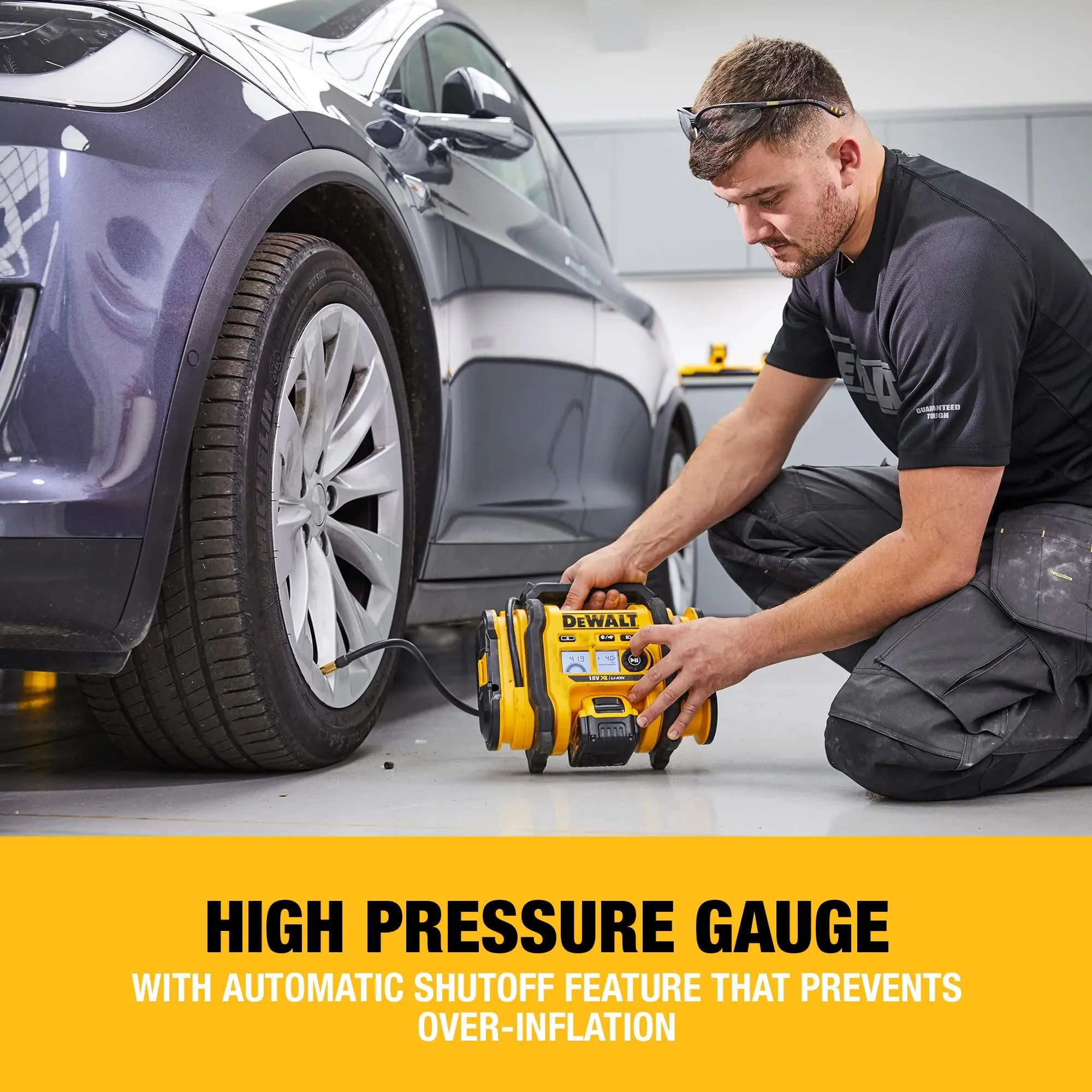
DeWalt 18V XR Digital Tyre Inflator

At £114.34, this sits at the premium end. But here's what you get: triple power source compatibility (18V XR battery, 12V, or 240V mains), high-accuracy digital gauge, and a compact form factor designed for site use. For tradespeople already on the DeWalt XR platform, it slots right into your existing kit. I've used it on everything from van tyres to wheelbarrow wheels on site — yes, wheelbarrow tyres are a genuine pain without the right kit. Genuinely versatile.

Key spec: The DeWalt 18V XR inflator delivers approximately 5-6 full car tyre inflations per 5.0Ah battery charge, with a maximum working pressure of 150 PSI and ±0.5 PSI gauge accuracy.

CO2 and Mini Pumps for Cyclists and Motorcyclists

Different world entirely. Cyclists need something that fits in a jersey pocket or mounts to a frame. Speed matters when you're stuck on a country lane 30 miles from home., meeting British quality expectations

CO2 Cartridge Inflators

A 16g CO2 cartridge inflates a 700c road tyre to 100 PSI in about 3-5 seconds. Brands like Lezyne, Genuine Innovations, and Crankbrothers all make reliable trigger-style dispensers for £15-£25. Cartridges cost £2-£4 each. The downside? One shot per cartridge. Miss your valve or have a second puncture and you're walking.

For mountain bikers running tubeless at lower pressures (25-35 PSI), a single 16g cartridge can fill a 29er tyre comfortably. Road cyclists at higher pressures might want 25g cartridges for full inflation.

Mini Hand Pumps

Unlimited air supply — just limited by your patience and arm strength. The Topeak Road Morph G (£35) includes a built-in gauge and foot peg, making it far easier than a standard mini pump. Expect 5-8 minutes of pumping for a road tyre. Not glamorous, but reliable.

Compact Electric Bike Pumps

The newer category. Small rechargeable units like the Xiaomi Mi Portable Air Pump (£35-£45) handle bike tyres brilliantly. 150 PSI max, USB-C charging, fits in a bottle cage. They'll do a car tyre too, but slowly — about 8-10 minutes. For commuters and weekend riders, these are spot on. Check our inflator pump guide for more options in this category.

Looking for the right tool? Check the cordless tire inflator for full UK specs.

Head-to-Head Comparison: Best Portable Tire Inflator Models

Model Price (2026) Power Source Max PSI Car Tyre Time Best For
AA Digital 12V £30-£35 12V socket 100 PSI ~3 min Budget emergency use
Ring RTC1000 £40-£50 12V socket 100 PSI ~3.5 min Reliable all-rounder
AstroAI Cordless £45-£55 Built-in battery 150 PSI ~4 min Budget cordless
Michelin 12266 £55-£65 12V socket 120 PSI ~2.5 min Premium 12V choice
Ryobi ONE+ R18PI-0 £55-£65 (bare) 18V ONE+ battery 150 PSI ~4 min Existing Ryobi users
Milwaukee M18 BI-0 £75-£90 (bare) 18V M18 battery 150 PSI ~3 min Trade professionals
DeWalt 18V XR £114.34 18V / 12V / 240V 150 PSI ~3 min Multi-source versatility
CO2 Cartridge (16g) £15-£25 + £3/cartridge CO2 cartridge 120 PSI N/A (bike only) Road cyclists

What to Look For When Choosing a Portable Tyre Inflator

Key technical specifications to look for in a portable inflator

Accuracy Matters More Than Speed

A gauge that's off by 3-4 PSI defeats the purpose. Look for models with ±0.5 PSI accuracy or better. The Which? tyre inflator reviews consistently flag accuracy as the most important differentiator between budget and mid-range models. I'd rather wait an extra minute for inflation than drive on incorrectly pressured tyres.

Auto-Stop Function

Set your target pressure, walk away. Essential. Without it, you're standing in the rain watching a gauge. Every model over £35 should have this. If it doesn't, skip it.

Power Source Compatibility

Think about where you'll actually use it. Boot of the car only? 12V is fine. Garage, shed, caravan, and car? You want cordless or multi-source. Working on site? Match your existing tool platform.

Build Quality and Duty Cycle

Cheaper inflators overheat after continuous use. Most budget models have a duty cycle of about 10-15 minutes on, then need 10 minutes cooling. Trade-grade units like the Milwaukee and DeWalt handle longer runs without thermal cutoff. If you're inflating multiple tyres in sequence — fleet vehicles, for instance — this matters.

Noise Levels

Something nobody mentions in spec sheets — and yet it's the first thing you notice at 7am on a quiet street. I've measured budget 12V inflators at 90+ dB. That's louder than a lawnmower. Cordless models tend to run quieter at 75-85 dB. Worth considering if you're inflating tyres early morning or late at night. The HSE noise exposure guidelines recommend hearing protection above 85 dB for prolonged use., popular across England

Included Accessories

Valve adaptors for Presta, Dunlop, and Schrader. A carry bag. Spare fuses for 12V models. LED work light. These extras don't cost manufacturers much but save you hassle. The digital tyre inflator options we've reviewed generally include a full adaptor set as standard.

Frequently Asked Questions

What is the best portable tire inflator for UK drivers in 2026?

For most UK drivers, the Ring RTC1000 offers the best balance of price (£40-£50), reliability, and accuracy at ±1 PSI. For cordless versatility, the DeWalt 18V XR at £114.34 provides triple power source options. Budget buyers should consider the AstroAI cordless at £45-£55 for decent cordless performance without platform lock-in.

Can I use a Ryobi or Milwaukee inflator on car tyres?

Yes, both the Ryobi ONE+ R18PI-0 and Milwaukee M18 BI-0 handle car tyres comfortably with 150 PSI maximum pressure. The Ryobi inflates a standard car tyre in approximately 4 minutes, while the Milwaukee manages it in about 3 minutes. Both require a separately purchased 18V battery if bought as bare tools.

Are CO2 bike inflators safe to use?

CO2 cartridge inflators are safe when used correctly with a proper trigger mechanism. The cartridge gets extremely cold during discharge (down to -40°C), so never touch it bare-handed. CO2 permeates through inner tubes faster than air, so re-inflate with a standard pump within 24 hours. Each 16g cartridge provides one full inflation of a 700c road tyre to approximately 100 PSI.

How often should I check my tyre pressure?

Check tyre pressure at least once a fortnight and before any long journey. Tyres naturally lose 1-2 PSI per month, with faster loss in cold weather. Always check when tyres are cold — at least 3 hours after driving or less than 2 miles travelled. Your vehicle's recommended pressures are on a sticker inside the driver's door frame or in the owner's manual.

Is a cordless inflator better than a 12V plug-in model?

Cordless inflators offer greater flexibility — use them anywhere without running the engine. However, 12V models never run out of charge and are typically £10-£20 cheaper. For emergency boot storage only, 12V is fine. For regular home use, garage work, or multiple vehicles, cordless wins on convenience. The best option depends on your usage pattern.

What PSI should my car tyres be?

Most UK passenger cars require between 30-36 PSI, though this varies by vehicle, tyre size, and load. Check your specific vehicle's placard — usually inside the driver's door jamb. Front and rear pressures often differ by 2-3 PSI. Never use the maximum pressure printed on the tyre sidewall; that's the tyre's limit, not your vehicle's recommended operating pressure.

Key Takeaways

  • Best overall value: The Ring RTC1000 at £40-£50 remains the benchmark 12V car tyre inflator for UK drivers in 2026, with proven accuracy and reliability.
  • Best cordless versatility: The DeWalt 18V XR at £114.34 offers unmatched flexibility with triple power source compatibility (18V battery, 12V, 240V mains).
  • Best for existing tool owners: Ryobi ONE+ (£55-£65 bare) or Milwaukee M18 (£75-£90 bare) — choose whichever platform you already own.
  • Best budget cordless: AstroAI at £45-£55 delivers solid performance without platform commitment, managing 4-5 car tyres per charge.
  • For cyclists: CO2 cartridges for speed (3-5 seconds), compact electric pumps like Xiaomi Mi (£35-£45) for versatility, mini hand pumps for reliability.
  • Accuracy is non-negotiable: Choose models with ±0.5 PSI accuracy minimum — incorrect pressure costs fuel and compromises safety.
  • Auto-stop saves hassle: Any inflator over £35 should include preset pressure with automatic shutoff. Don't settle for less.

Ready to equip your van with {brand_name}?

Upgrade Your Kit — £296.80